
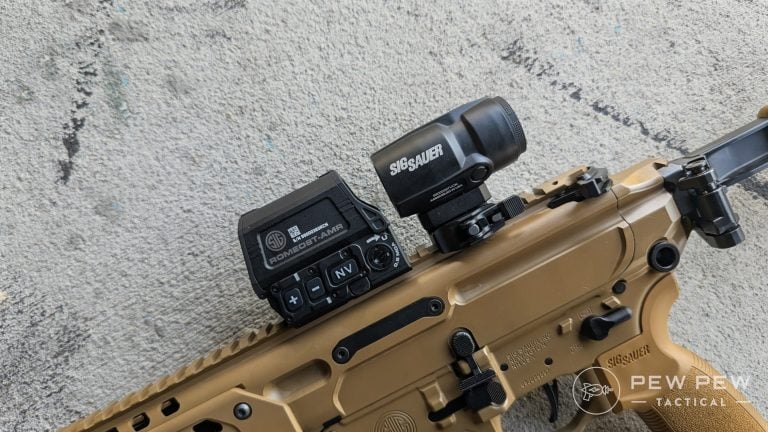
Sig Sauer Romeo8T-AMR Pros & Cons
Pros
- Brilliant reticle changing technology
- Crazy crisp reticles
- Large field of view
- No price increase for the new model
Cons
- Locked into the AMR ecosystem for magnifiers
The Bottom Line
The Romeo8T-AMR's simple sensors and magnets solve the technological problems we run into with red dots and magnifiers by providing instant adjustment. No more mulligans, no more reticles being too bright, or having to find the right reticle for a magnified and unmagnified view. While the optic remains locked to the AMR ecosystem's single magnifier option, it retains all the durability, a massive 40mm field of view, and crisp reticles of the original 8T, but in a lighter, shrunk-down package while maintaining the original model’s price point.
The firearms industry, and specifically the firearms media, use the term “game changer” a lot.
They say everything’s a game-changer, from the latest and greatest gun to the latest and greatest red dot. Needless to say, most things aren’t, and saying gets old fast.
With that said, I try not to use the term. Because I hope that when I do, it will actually matter, and today, it matters.
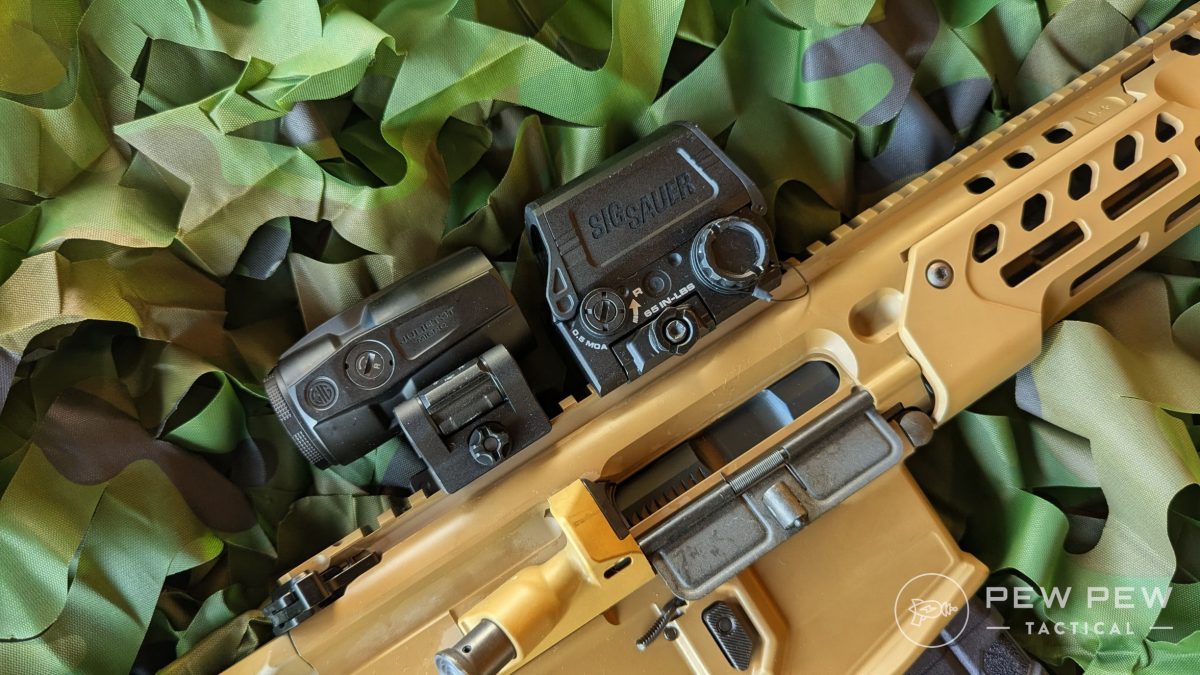
The Sig Romeo8T-AMR and magnifier combo is a game-changer. It’s a red dot and magnifier system that is doing what’s never been done before. I pinky promise that by the end of the article, you’ll agree. If not, flame me in the comments.
Table of Contents
Loading…
Prices accurate at time of writing
Prices accurate at time of writing
-
25% off all OAKLEY products - OAKLEY25
Copied! Visit Merchant
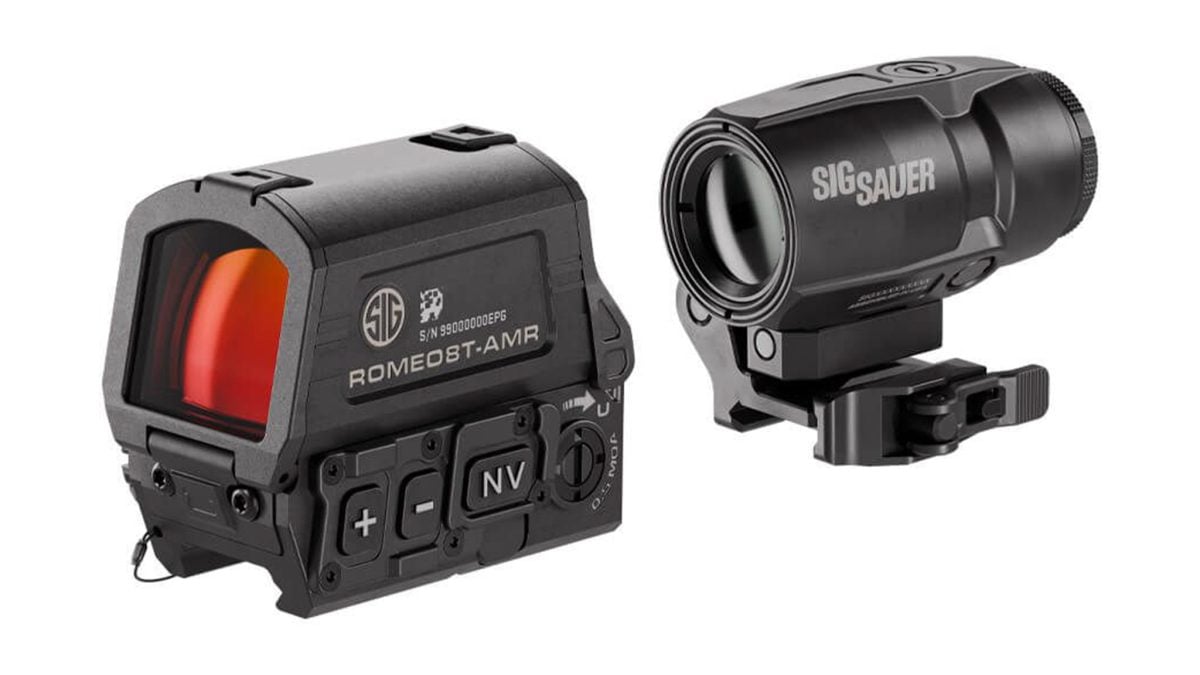
Sig Romeo8T-AMR & Juliet3T-AMR Specs & Features
Specs
- Romeo8T-AMR Magnification: 1X
- Lens Diameter: 40mm
- Reticle: QBCD 2.0
- Brightness Levels: 15
- Battery Life: 50,000 Hours
- Romeo8T Weight: 9.5 oz
- Juliet3T-AMR Magnification: 3X
- Juliet3T-AMR Weight: 9.7 oz
- Combined Weight: 19.2 oz
Features
- AMR (Automatic Modified Reticle) selectable reticle and brightness level for both magnified and unmagnified views
- MOTAC motion-activated shake-awake/auto-off technology
- Dedicated Night Vision button
- Removable sacrificial lenses
- PowerCam flip-to-side QD magnifier mount
Romeo8T-AMR Backstory
Sig produced the Romeo8T to be a professional-grade optic for duty users.
The original Romeo8T was a big, slightly hefty, but ultimately awesome optic. It was highly praised for its durability, its dot clarity, and its night vision and magnifier performance.
People said it was built like a tank due to its beefy construction. It had a big window, a great FOV, and multiple reticle options.
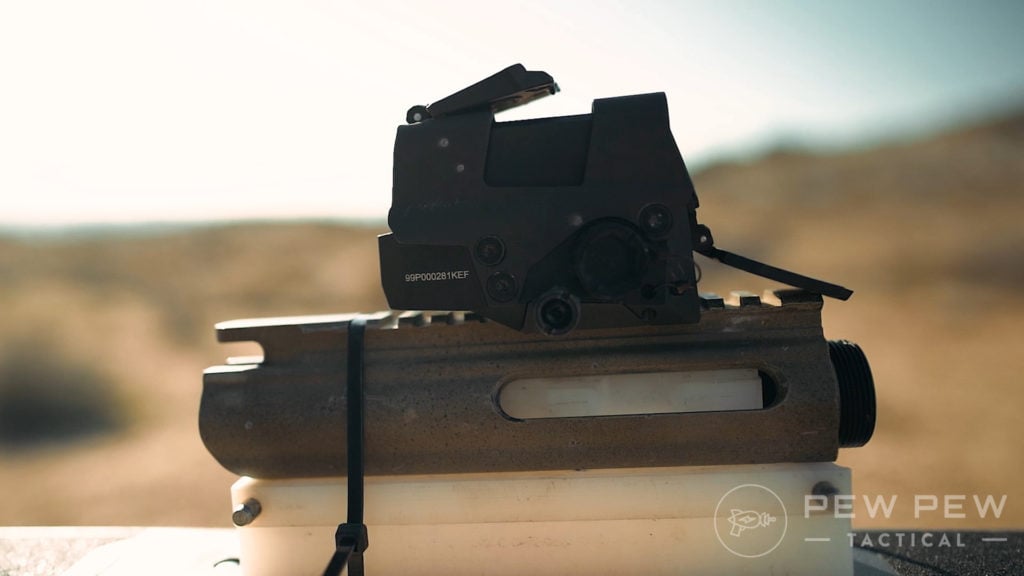
But Sig decided to take all of those excellent features and make them even better with the Romeo8T-AMR.
They kept the same reticle designs, night vision performance, and durability, while reducing the size, making it lighter, and integrating their new AMR technology – all without raising the MSRP.
Shooting With the Romeo8T-AMR: Reliability Analysis
“Mulligan!” is a phrase I’ve said both out loud and to myself when shooting drills with magnifiers.
This typically occurs when I’m shooting multi-distance drills or moving from short-range to moderate-range drills. I flip the magnifier in place, the timer goes off, and I flip the gun up and on target, only to find a reticle that’s way too bright.

The magnifier is amplifying light, and that includes your reticle. It gets trickier in bright scenarios, like what I face at every outdoor range in Florida.
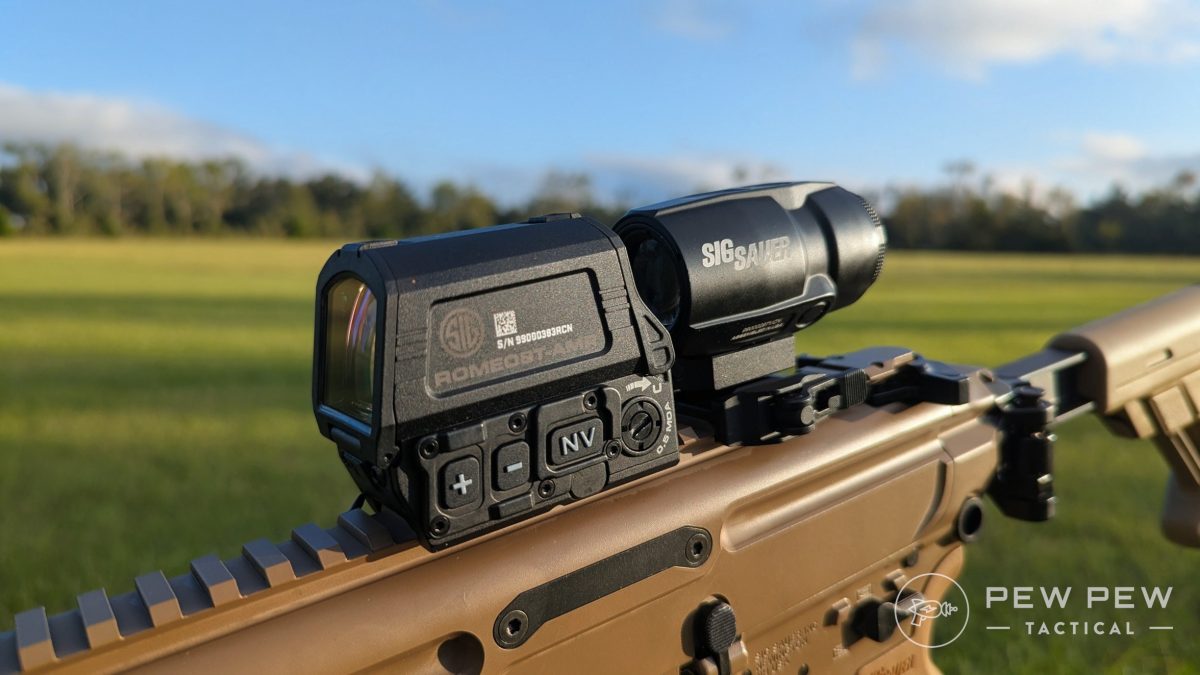
Right off the bat, the Romeo8T AMR fixes that issue by allowing for automatic reticle and brightness changes when the magnifier is moved into place. This is achieved by using simple magnets and sensors in both the dot and magnifier that interface when they are close.
I’ve programmed my Romeo8T-AMR to dial the brightness down two levels when the magnifier is flipped into place. Real life has no mulligans, and I like an optic that reflects real life.
I like circle-dot reticles a lot, and the Romeo8T-AMR gives me two. The first is just a standard 65 MOA circle and a 2 MOA dot.
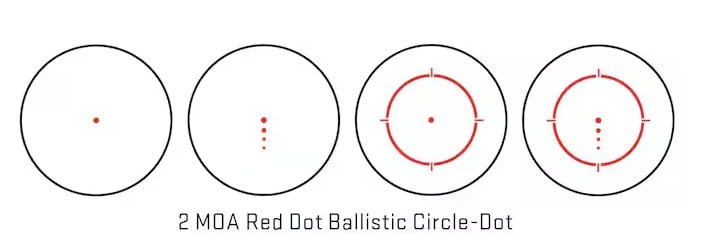
The second is a circle-dot with three 1 MOA dots beneath the main 2 MOA dot, with the first dot being 5 MOA below the 2 MOA dot, the second 9 MOA below, and the third 15 MOA below.
This specific reticle corresponds to the bullet drop at 350 meters, 500 meters, and 700 meters when firing 5.56 from a 14.5-inch barrel.
A bullet drop reticle isn’t all that handy when not using a magnifier. So I program the AMR system to show the standard circle and dot when unmagnified, but then switch to the ballistic drop reticle when I put the magnifier in place.
This system works like a dream. It’s an instant switch. As soon as the magnifier is in place, the reticle swaps, and the brightness drops.
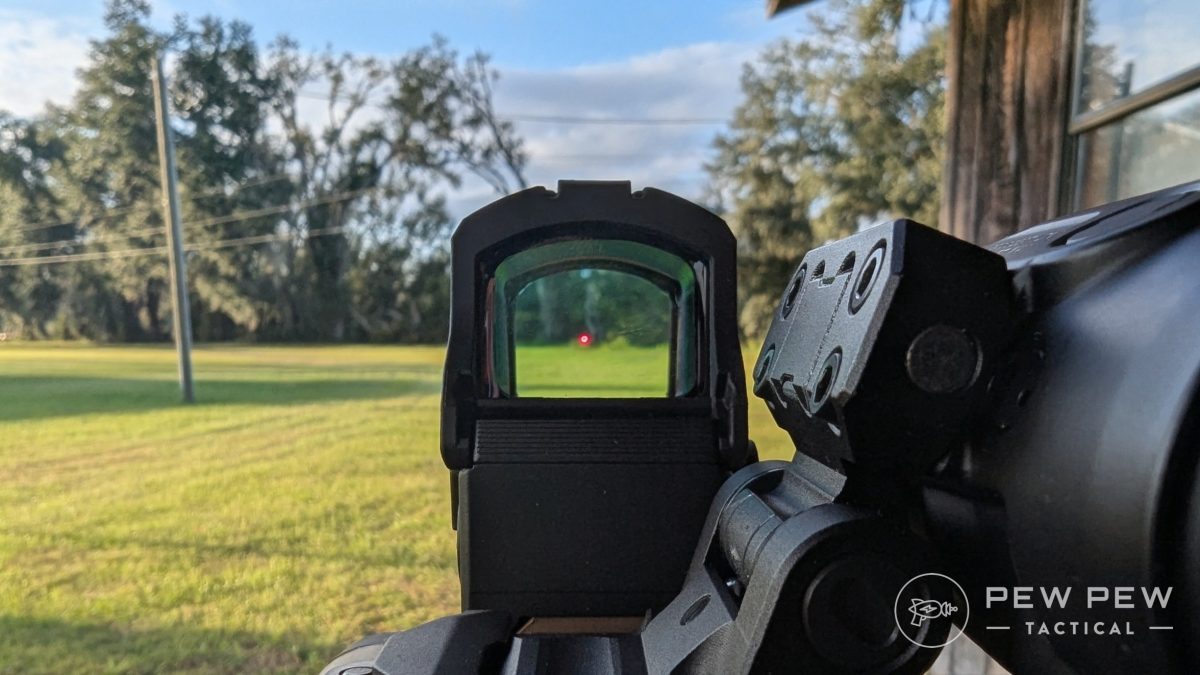
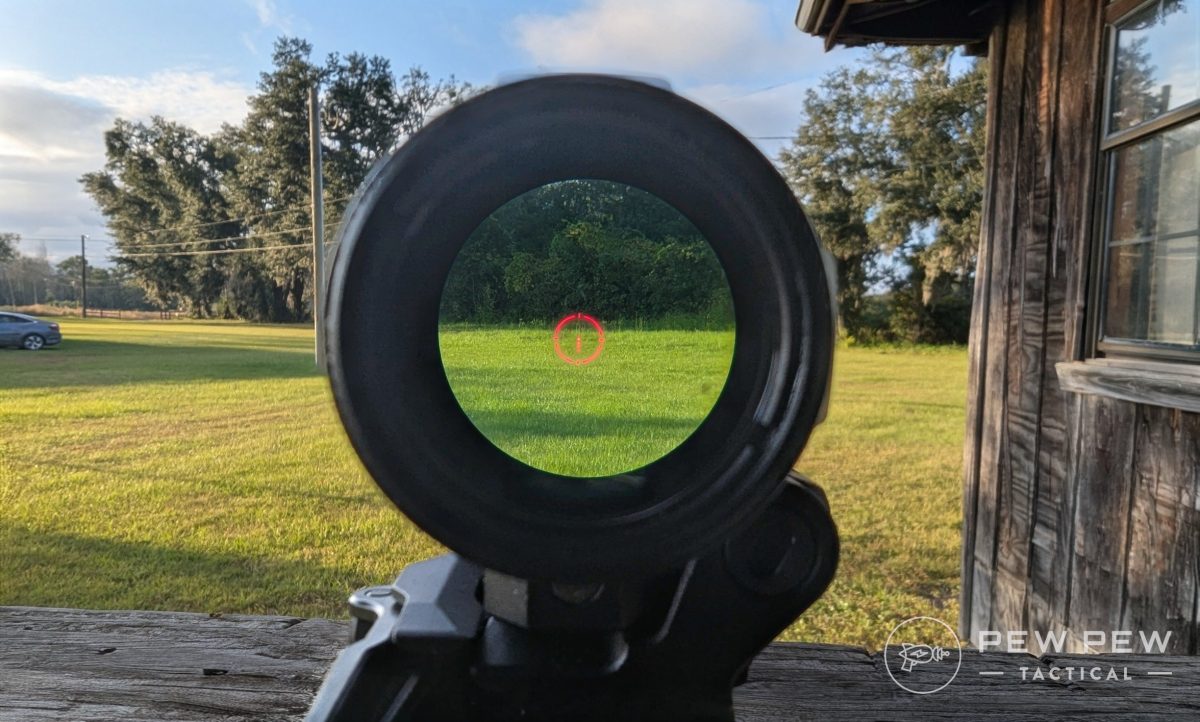
I shot several drills at various ranges, engaging large steel, then transitioning to a magnified view to hit smaller targets. It’s a clear and easy transition.
At longer distances, I have instant access to holdovers that provide prism-optic-like capabilities. The dots are easy to see and make a lot of sense under magnification. Going with 1 MOA dots makes a lot of sense since they don’t grow too much under a magnifier.
Optical Performance
Beyond the magnifier and instant swap combo, the Romeo8T-AMR still offers an excellent red dot all around. The dots are very crisp and clear; each reticle is easy to see. There is a noticeable notch filter that gives everything a slight blue tint, but the overall glass clarity is good.
There is no stutter, indicating a good refresh rate. I used the light with the sun behind, in front, and to the left and right of me, and didn’t have any reflection issues.
The generously sized viewing window makes it easy to find the reticle, especially for newer shooters. It’s also handy for those awkward shooting positions where the fundamentals and good head position might be compromised.
The magnifier looks clear and bright, providing a solid 3X level of magnification. It’s small, but the eye box isn’t restrictive. It sports a 2.5-inch eye relief, which means you do need to be fairly close, but not ACOG close.
Ergonomics: Fit & Feel
I like my optics to be absolutely adhered to my gun. I recently took a Steiner MPS to the head when a mounting bolt broke on the optic as I was shooting.
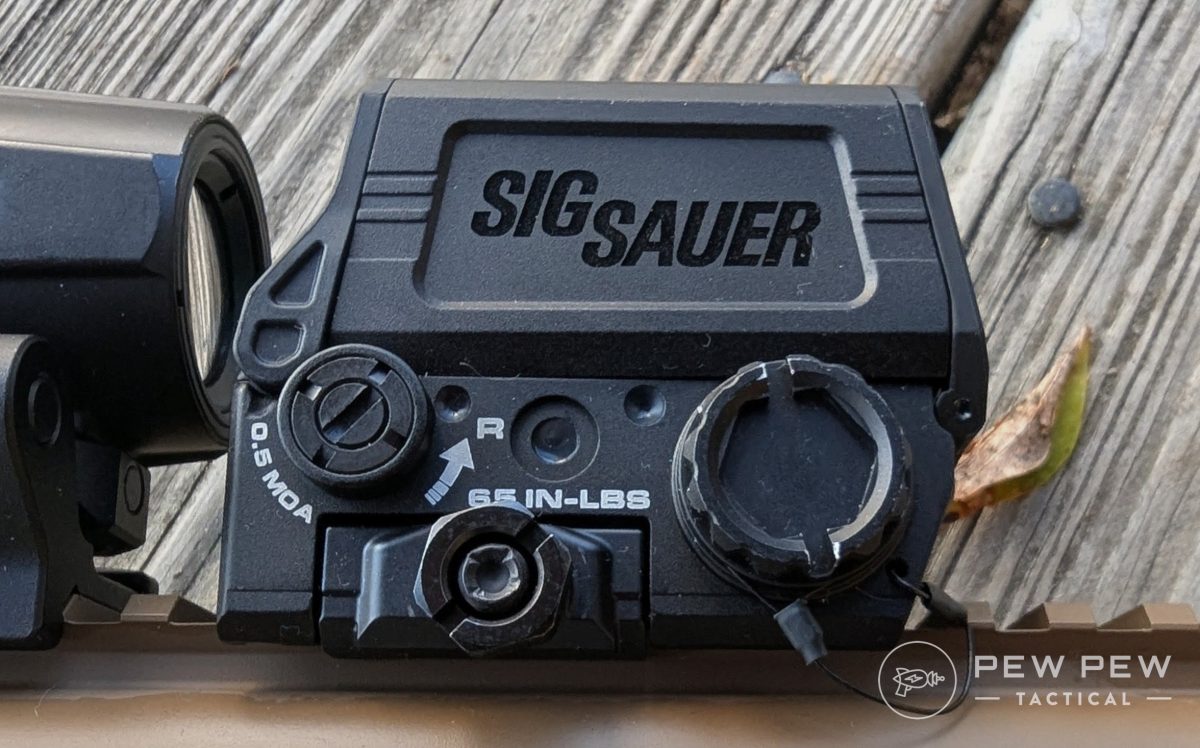
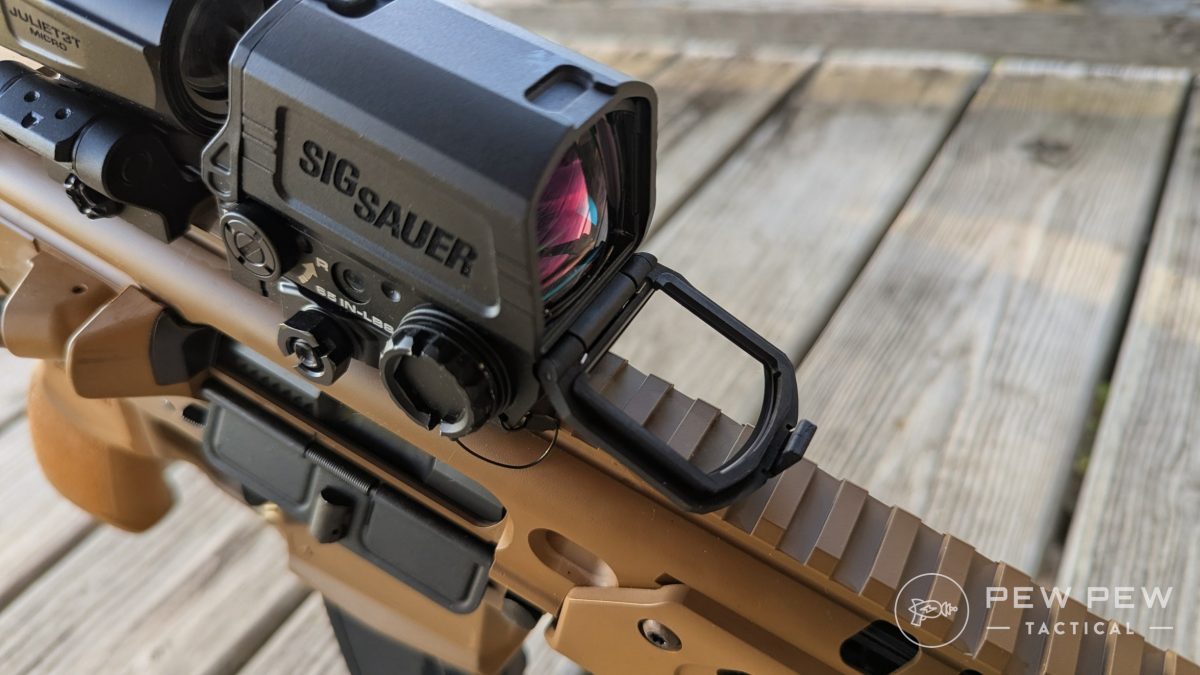
The Romeo8T-AMR has a massive, chunky bolt to lock the optic to the gun. It’s a big bolt and might be an issue if you use a rifle with a left-side charging handle.
The buttons are rubberized and tactile. It’s easy to know when a press is a real press. The button has enough resistance to prevent accidental presses if the optic bumps into your gear.
Including a dedicated night vision button is a brilliant touch that makes transitioning from NV use to bright light exceptionally easy.
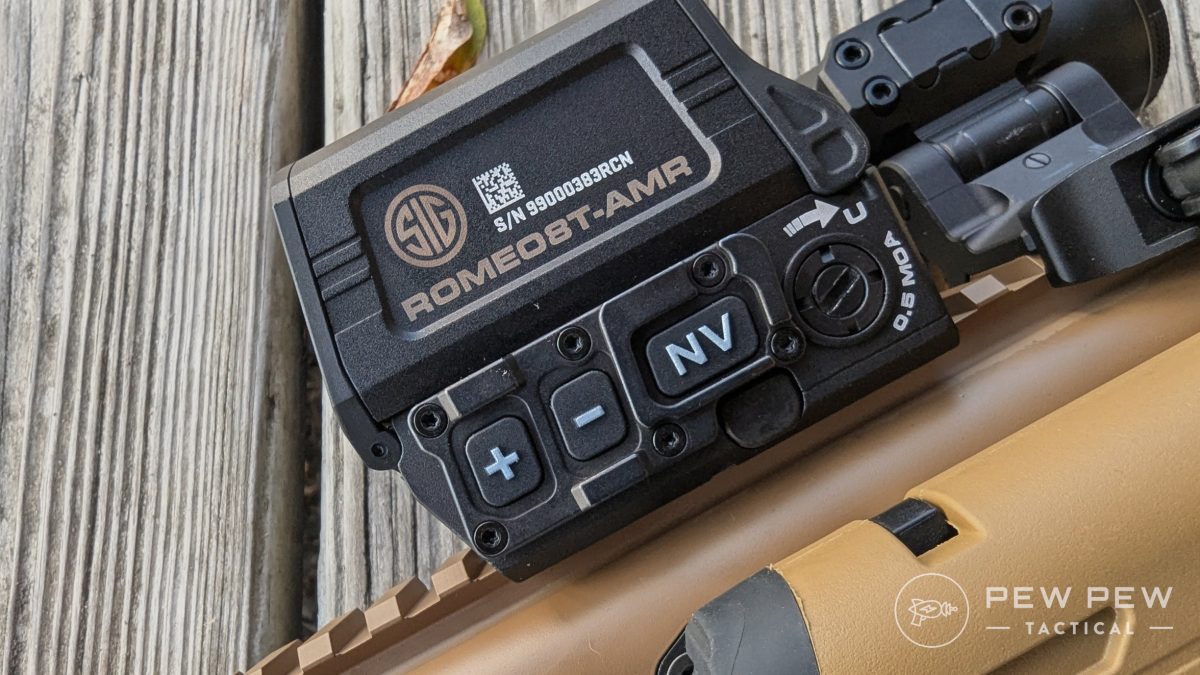
But I have to complain about how reticles are switched. You hold down both buttons, and the reticles start swapping between the four. Once it lands on the reticle you want, you hit another button.
Miss your timing, and you’re waiting again. It’s not a big deal, but it took me by surprise. This is the first time I’ve ever seen a system like this.
The Romeo8T features a clean, side-mounted battery that is easy to access. It houses a single CR123A battery that provides up to 50,000 hours of battery life when MOTAC is enabled.
Juliet3T-AMR Magnifier
The magnifier doesn’t have a dedicated lock, so it flips back and forth easily but won’t flop around on its own. It requires some dedicated movement to move the magnifier in and out of place. The magnifier features a simple QD lever for easy and clean attachment and detachment.
Everything about the magnifier is set up perfectly with the Romeo8T AMR, and it should be, since it’s AMR-specific.
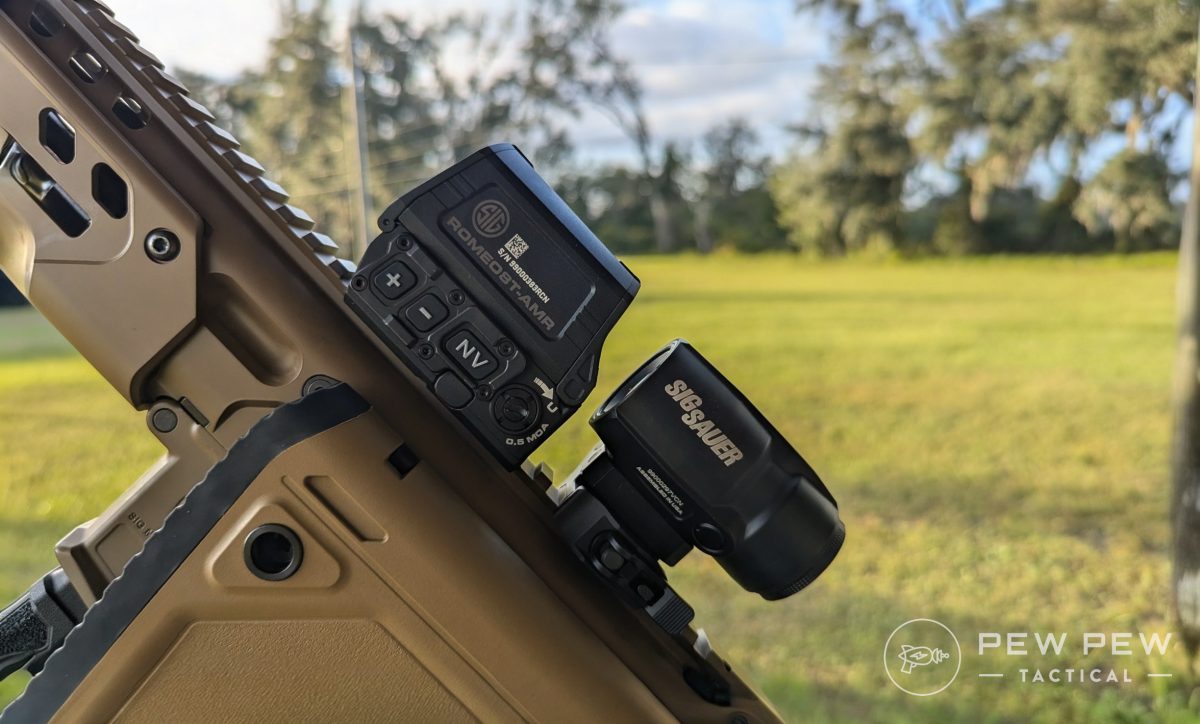
This setup is most beneficial for users who use the magnifier, and as such, I tend to focus on the combined unit’s weight of 19.2 ounces.
There are lighter red dot and magnifier combos, such as the Holosun HS503 with a Vortex Micro 3X, which have a combined weight of 13.29 ounces. That being said, the 8T-AMR combo isn’t terribly heavy. It weighs about the same as an EOTech with a G33 magnifier.
Improvements We’d Like to See
My biggest gripe is being stuck in the AMR ecosystem and only having one magnifier option. I want to see Sig expand the magnifier options. If I had a 5X or even a 6X magnifier option, I might argue that the AMR setup could be a serious challenger to LPVOs.
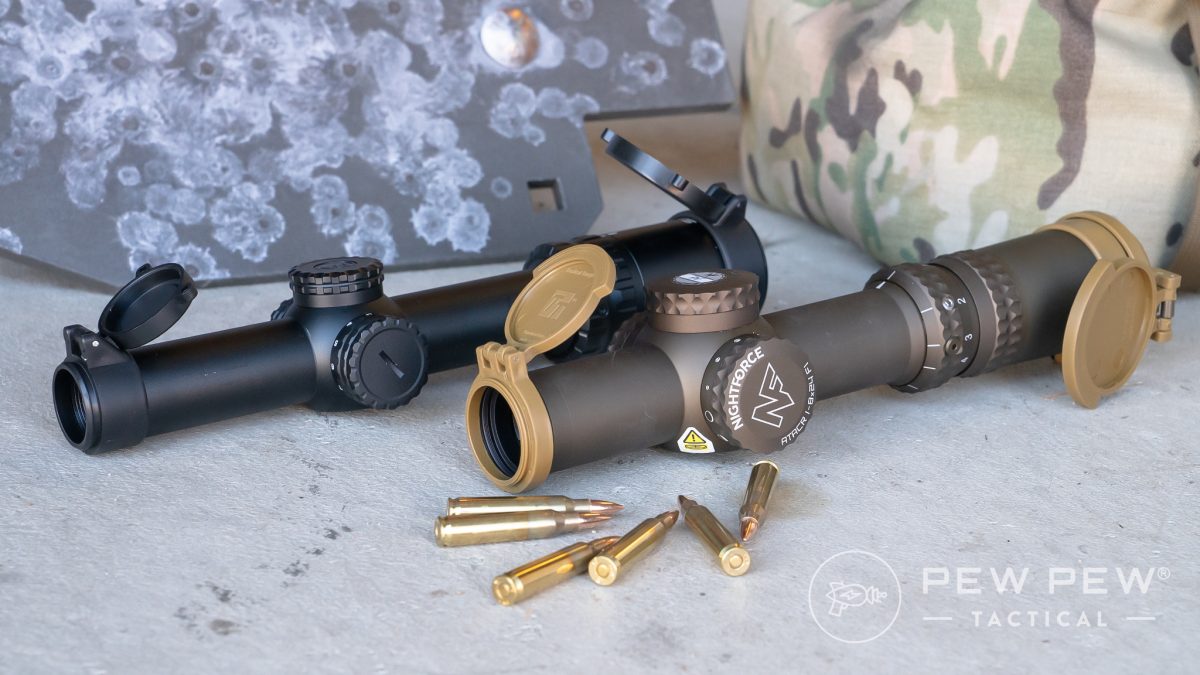
I would like to see a less aggressive notch filter; the glass is darker than the original 8T, but not enough to be a major issue.
I’d also just like to press buttons to switch between reticles instead of the carousel that stops on another button press.
Who Is It For?
Professional and duty-level shooters looking for a strong, durable optic that performs well under night vision will be well served with the Romeo8T-AMR.
It is also a fantastic option for recreational shooters who shoot at a variety of ranges and don’t want the restrictions and downsides of an LPVO.
The AMR technology provides a super-simple system for automatically adjusting your reticle and brightness under a magnifier. It’s the only optic on the market to employ this type of technology, and it’s a brilliantly simple design overall.
By the Numbers
Reliability: 5/5
No reliability issues at all. The optic never lost zero, never stuttered, and the magnifier always switched reticle and brightness on demand.
Ergonomics: 4/5
The setup isn’t overly heavy, the buttons are large and easy to reach, and the NVG button is a nice touch. I do wish I could just cycle reticles manually instead of navigating a carousel.
Value: 3/5
At around a thousand dollars, it’s not cheap, but it’s actually a little cheaper than the original 8T and comes with a fairly nice magnifier.
Overall: 4/5
The Romeo 8T AMR and magnifier are a solid combo that offers excellent performance. It’s innovative in a field that has long lacked innovation.
Prices accurate at time of writing
Prices accurate at time of writing
-
25% off all OAKLEY products - OAKLEY25
Copied! Visit Merchant
How We Tested the Romeo8T-AMR
The Romeo8T-AMR and Juliet3T-AMR were mounted to a Sig MCX Spear-LT and zeroed with the gun on a Zeiss Pro Series tripod.
I tested Romeo8T AMR at various shooting distances, starting up close and using the red dot for ready-up drills, Bill Drills, failure-to-stop drills, and a few V-TAC 1-5 drills.
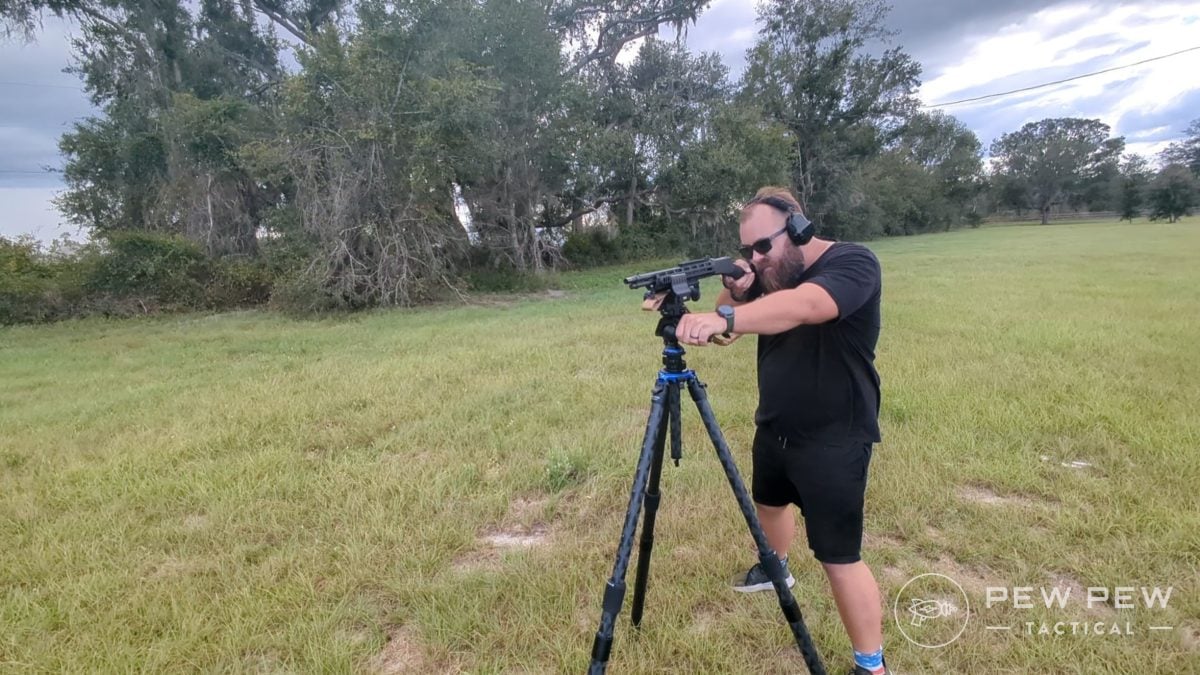
I also shot from behind cover and worked dry fire in odd positions around my vehicle and inside my home to test the eye box and field of view with the optic’s 40mm lens.
At 100 yards, I ran drills shooting large IPSC steel targets with the red dot, switched to the magnified view, and engaged reduced-size IPSC targets and gongs ranging from 10 to 4 inches.
Meet The Experts

Pew Pew Tactical author Travis Pike wrote this article. Travis spent a lifetime shooting as a kid and later joined the United States Marine Corps, where he spent five years as an infantryman. His experience as a machine gunner, recreational shooter, and hunter has given him unique insight into various weapon platforms. Additionally, Travis has thousands of articles to his name in a variety of publications. In addition to testing countless guns and firearm accessories, Travis has spent time behind a wide range of optics on numerous platforms, so he knows what works and what doesn’t.
Final Verdict on the Sig Sauer Romeo8T-AMR
The Romeo8T-AMR is a true game changer. It’s one of the few times a new red dot hit the market and provided us with something truly new.
The simple integration of magnets and sensors has delivered us a red dot and magnifier combo that not only solves problems but also increases effectiveness.
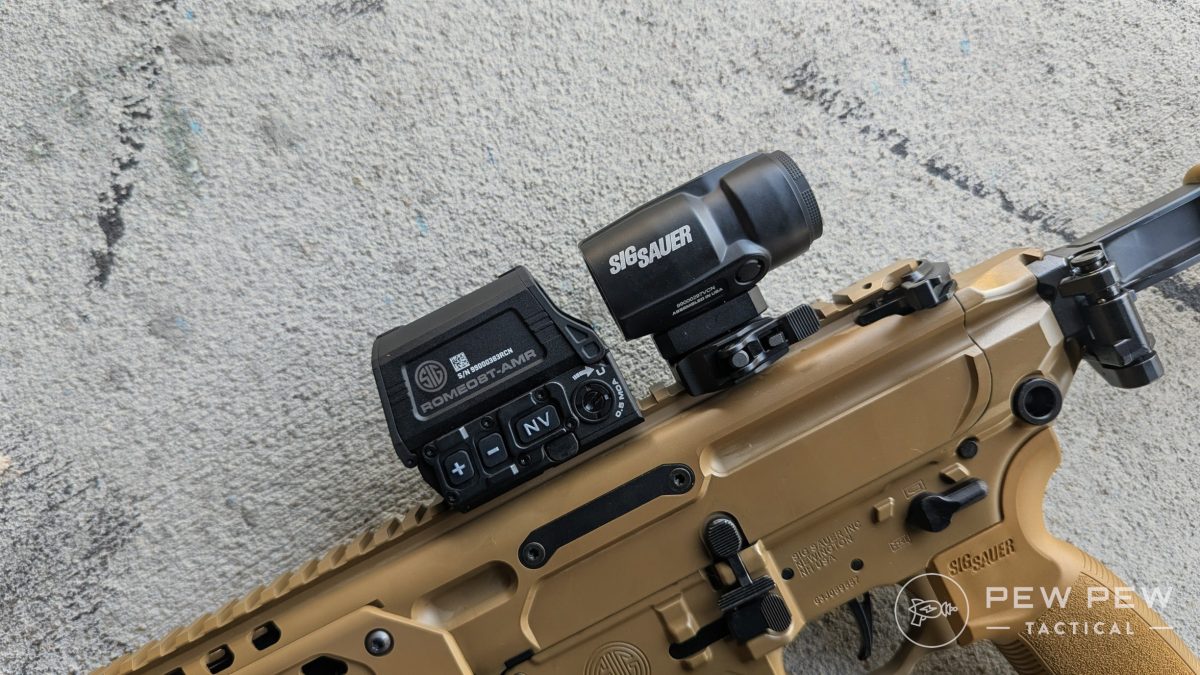
While the $999 price tag for the combo isn’t budget-friendly, it’s surprisingly affordable considering the technology it utilizes. The fact that they kept it in the same price realm as the original 8T impresses me.
What do you think of the Romeo8T-AMR combo? Is it a game-changer? Or am I being over the top? Let us know in the comments below! Looking for other options? Be sure to check out our hands-on article on the Best Red Dots!













Leave a Reply