
[Tested] Best Trigger Pull Gauges: Mechanical & Digital

We tested several trigger gauges to find the very best ones. From affordable mechanical options to pricier digital, come see what we recommend.
We review products independently. When you buy through links on our site, we may earn a commission to help support our testing. Learn more.
Have you ever looked at one of your guns and wondered, “How heavy is that trigger?”
Well, you don’t have to wonder any longer.
We tested the most popular trigger pull gauges on the market to determine which are most accurate and easiest to use.
Let’s dive in!
The Quick List
- Best Digital Gauge: Wheeler Professional Digital Trigger Pull GaugeJump to Details ↓
- Best Manual Gauge: Birchwood Casey Firearm Trigger ScaleJump to Details ↓
- Best for Heavier Triggers: Lyman Mechanical Trigger Pull GaugeJump to Details ↓
- Best for Wide Triggers: Wheeler Manual Trigger Pull ScaleJump to Details ↓
Table of Contents
Trending: Best AR-15s, Best Pistol Red Dots, & Ammo in Stock
Trigger Pull Gauge Comparison Chart
| Gauge Type | Max measurement range | Measurement increments | Average Trigger Gauge Pull Measurements | Dvorak TriggerScan Baseline Measurements | Price | |
|---|---|---|---|---|---|---|
| Wheeler Professional Digital Trigger Pull Gauge | Digital | 0 lbs -12 lbs | 1 oz | 5.6 lbs (single-action) 11.8 lbs (double-action)** | 5.7 lbs (single-action) 10.6 lbs (double-action) | $53 |
| Birchwood Casey Firearm Trigger Scale | Manual | 0 lbs - 11 lbs | 1/4 lb | 5.3 lbs (single-action) 10.2 lbs (double-action) | 5.7 lbs (single-action) 10.6 lbs (double-action) | $15 |
| Lyman Mechanical Trigger Pull Gauge | Manual | 0 lbs -12 lbs | 2 oz | 4.6 lbs (single-action) 11.4 lbs (double-action) | 5.7 lbs (single-action) 10.6 lbs (double-action) | $19 |
| Wheeler Manual Trigger Pull Scale | Manual | 8 oz - 8 lbs | 2 oz | 6.1 lbs (single-action) N/A (double-action)*** | 5.7 lbs (single-action) 10.6 lbs (double-action) | $21 |
| Lyman Digital Trigger Gauge | Digital | 0 lbs - 12 lbs | 1/10th lb, whole grams | 5.4 lbs (single-action) 11.4 lbs (double-action) | 5.7 lbs (single-action) 10.6 lbs (double-action) | $43 |
** Indicates gauge was reading OVERLOAD
*** Indicates gauge only goes to 8 lbs
How We Tested the Best Trigger Pull Gauges
This list is the result of extensive hands-on testing, with some of these items having been in personal use for years. We set out to find which gauges offer the best features, the greatest accuracy, and the easiest use in a real-world setting. And as always, we strongly consider price and overall value when ranking our picks.
Testing Protocol
To test the accuracy of each gauge, I first grabbed a baseline control reading using a calibrated Dvorak TriggerScan machine and a Smith & Wesson 5906 handgun.

I took a three-pull average in both single-action and double-action trigger modes.
Next, I gathered a three-pull average for each trigger gauge in both single- and double-action modes on the handgun.
Here are the calibrated Dvorak TriggerScan readings against which I compared the results of each trigger pull gauge.
Meet the Experts
Updating this article is Pew Pew Tactical Editor, Wyatt Sloan. Wyatt is a former NRA and USCCA-certified instructor, avid hunter, and a former competitive shooter. His personal collection includes over 200 firearms.

He has long had a curiosity when it comes to triggers. He has turned that interest into research, authoring various trigger upgrade comparison articles for Pew Pew Tactical using the Dvorak TriggerScan machine, including Best Glock Triggers and Best S&W M&P 2.0 Triggers.
Best Trigger Pull Gauges
1. Wheeler Professional Digital Trigger Pull Gauge – Best Digital Gauge
Pros
- Very accurate, especially for single-action
- Intuitive and easy-to-use menu
- Backlit screen
- Stable during use
Cons
- Says it reads up to 12 lbs, but really only properly reads to around 11.5 lbs
- Large grip is slightly awkward to hold
Specs
- Gauge type: Digital
- Max measurement range: 0 lbs -12 lbs
- Measurement increments: 1/10th
| S&W 5906 | Single-Action | Double-Action |
|---|---|---|
| Wheeler Digital average measurements | 5.6 lbs | 11.8 lbs** |
| Dvorak TriggerScan baseline measurements | 5.7 lbs | 10.6 lbs |
** Indicates gauge was reading OVERLOAD
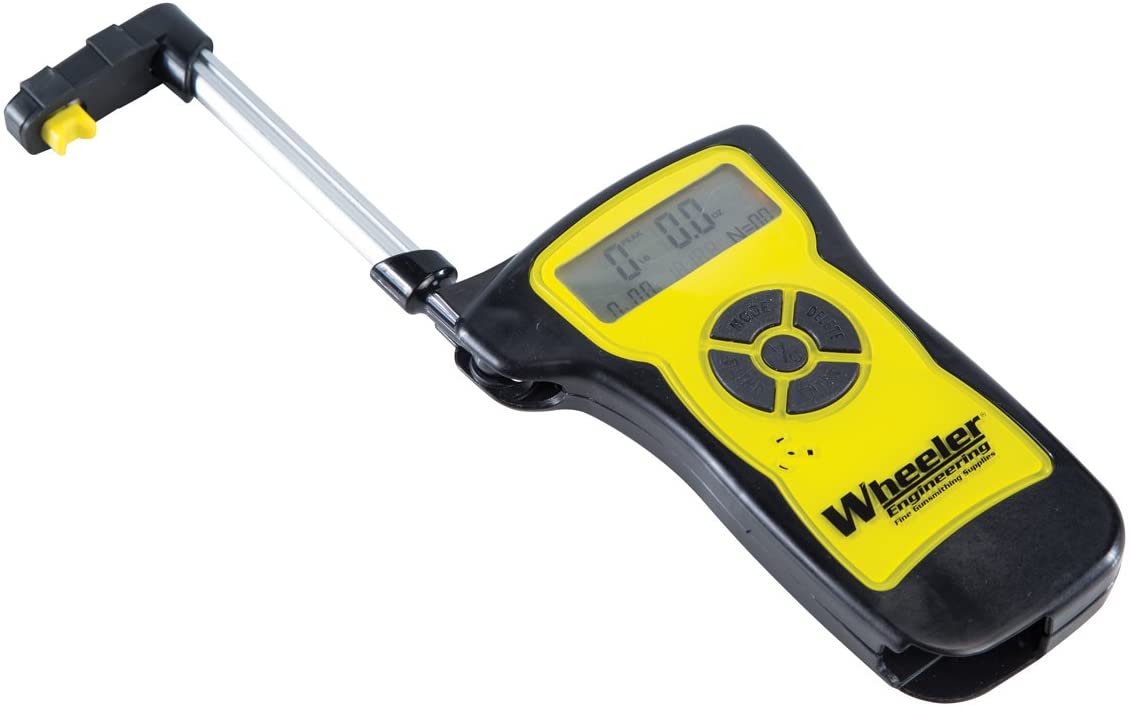
The Wheeler Professional Trigger Pull Gauge was my favorite of the two digital gauges I tested.

It features a backlit screen that makes it easy to keep track of everything at once, including the current pull weight, the number of pulls you have done, and the average of all your previous pulls.
I like that the interface is extremely intuitive and easy to navigate, even without instructions.
The hook arm can be rotated and locked into four different positions every 90 degrees. It is very stable in each position, which is extremely important so that it doesn’t move around during the pull process.

Wheeler includes two different pads that interface with the trigger. The first is an aggressively curved one that works well with skinnier triggers, and the second has a gentler curve for wider triggers.
I do have two minor complaints. The gauge itself is a bit wide, so holding onto the sides is a little more awkward than with other gauges.
My second gripe is that Wheeler claims the gauge reads up to 12 lbs. However, once I was getting around the 11.5 lb mark, it kept reading “OVERLOAD.”
However, if you aren’t measuring extremely heavy double-action triggers, the Wheeler Professional Gauge is the most stable, intuitive, and accurate digital gauge on the market.
What do you think of the Wheeler? Rate it below!
Readers’ Ratings
4.99/5 (1865 Votes)
Your Rating
2. Birchwood Casey Firearm Trigger Scale – Best Manual Gauge
Pros
- Very consistent readings
- Pretty accurate readings
- Rubberized grip is nice and comfy to use
- Great hook design
- Amazing value
Cons
- Plastic ring that indicates the results moves too easily
Specs
- Gauge type: Manual
- Max measurement range: 0 lbs - 11 lbs
- Measurement increments: 1/4 lb
| S&W 5906 | Single-Action | Double-Action |
|---|---|---|
| Birchwood Casey average measurements | 5.3 lbs | 10.2 lbs |
| Dvorak TriggerScan baseline measurements | 5.7 lbs | 10.6 lbs |
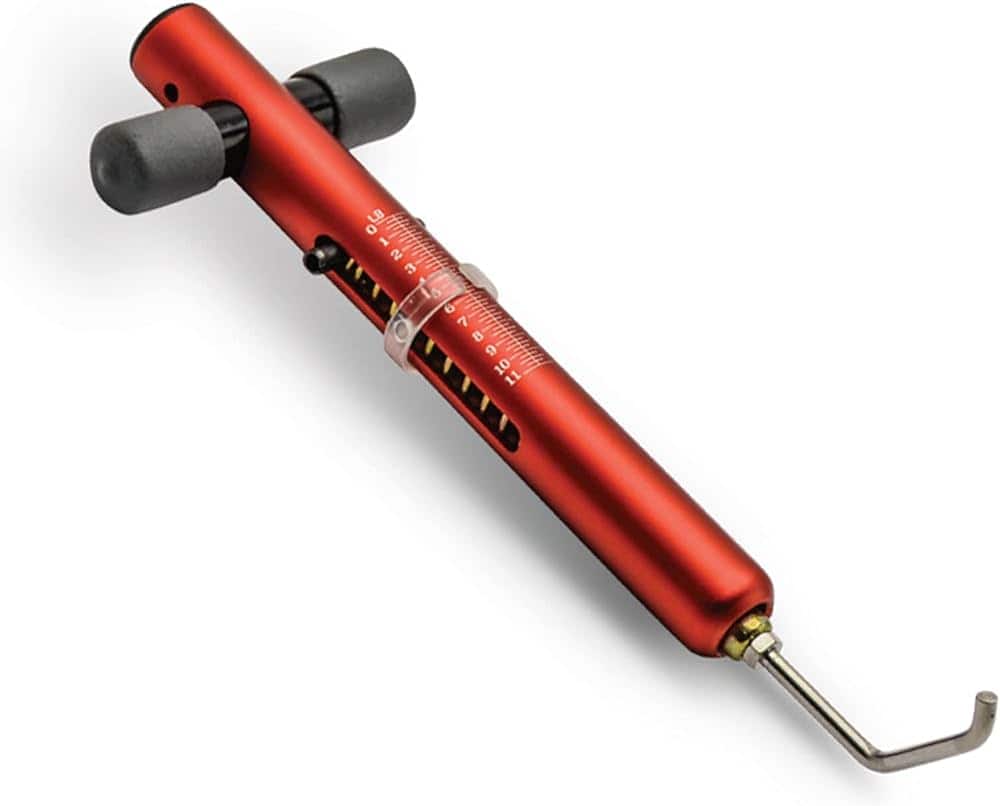
This manual gauge uses a simple spring-and-ring setup.
The Best Gun Deals, Coupons and Finds
Subscribe to Pew Pew Tactical's sales and deals email.

When you pull the gauge back, it moves a small plastic ring up the body. The ring then stays where the peak force is measured, making it easy to read.
This particular hook design feels the most stable on the trigger, and I can keep it right where I want to with minimal movement.
It features an all-aluminum body with a rubberized T-grip that provides a lot of control.
I strongly believe that the hook and rubberized grip helped make this the most accurate manual gauge of the bunch.
The hook is reversible, but it requires a small wrench to do so. It should also be noted that the Birchwood Casey has the fewest measurement increments.

My only concern is that the plastic ring that provides the reading is extremely easy to move. You have to be very careful not to disturb the ring after the measurement is taken.
What do you think about the Birchwood Casey Trigger Pull Gauge? Rate it below!
Readers’ Ratings
4.99/5 (1865 Votes)
Your Rating
3. Lyman Mechanical Trigger Pull Gauge – Best for Heavier Triggers
Pros
- The large T-handle provides a very solid grip
- Trigger interface pad is shaped nicely
- Can safely measure up to 12 lbs
Cons
- Free spinning arm makes getting single action readings a bit harder
Specs
- Gauge type: Manual
- Max measurement range: 0 lbs - 12 lbs
- Measurement increments: 2 oz
| S&W 5906 | Single-Action | Double-Action |
|---|---|---|
| Lyman Mechanical average measurements | 4.6 lbs | 11.4 lbs |
| Dvorak TriggerScan baseline measurements | 5.7 lbs | 10.6 lbs |
My second-favorite pick for manual gauges is the Lyman trigger pull gauge.

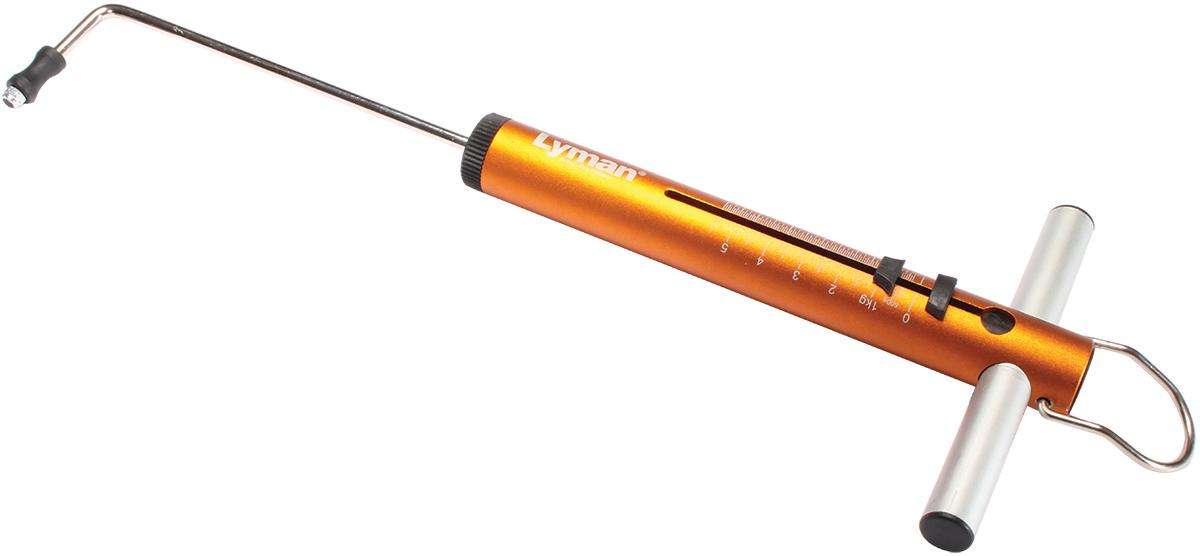
It features an all-aluminum body with a very large T-handle that is easy to grip.
You get unit scales in both pounds and kilograms. The increments are also pretty fine, being 2 oz and .1 kg, respectively.
The hook arm has a 90-degree hook topped by a gently curved trigger pad that rests neatly on the trigger face.

However, the arm does not lock into place; it spins freely. This gave me some trouble, as the arm tends to move around on the trigger when I first start pulling.
It is best to start the measurement process by giving the gauge a hard tug to keep it from moving as much.
The results are easy to read, and the gauge feels well-made, but the lack of an arm that locks into place instead of free-spinning puts this one just below the Birchwood Casey for me.
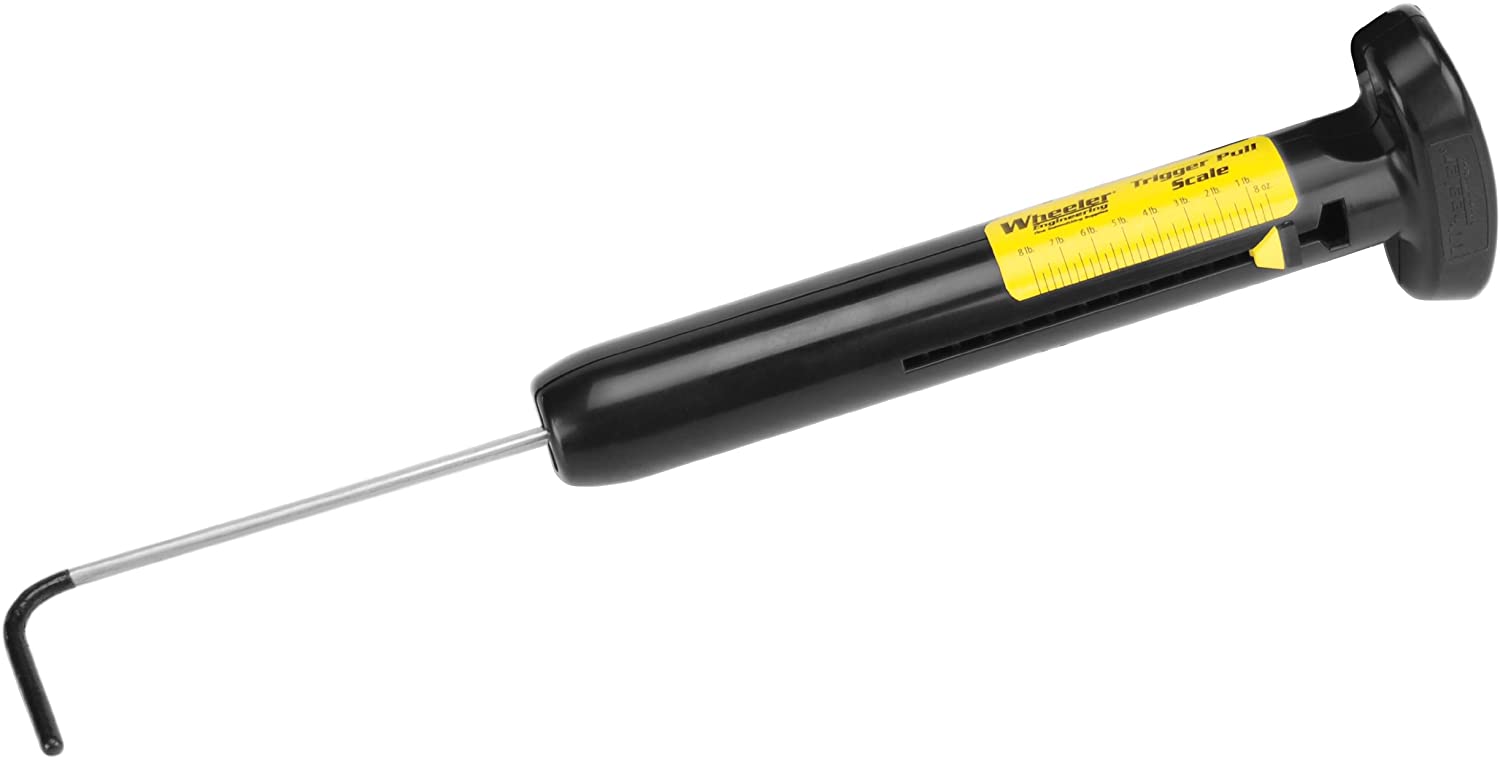
4. Wheeler Manual Trigger Pull Scale – Best for Wide Triggers
Pros
- Long hook is suitable for wide triggers
- Easy to find for sale
Cons
- T-handle is too small
- Arm spins freely which reduces overall stability and repeatability
- Only goes up to 8 lbs
Specs
- Gauge type: Manual
- Max measurement range: 8 oz - 8 lbs
- Measurement increments: 2 oz
| S&W 5906 | Single-Action | Double-Action |
|---|---|---|
| Wheeler Manual average measurements | 6.1 lbs | N/A*** |
| Dvorak TriggerScan baseline measurements | 5.7 lbs | 10.6 lbs |
*** Indicates gauge only goes to 8 lbs
Wheeler is well-known for their wide range of gunsmithing tools, so it is no surprise to see that they also make a manual gauge in addition to their digital gauge.

This unit has a plastic body with a very small integrated T-handle at the bottom. It uses a sliding weight indicator like the other manual gauges.
The hook arm is thin and has a simple 90-degree rubberized bend. A lengthy horizontal hook length means you have plenty of real estate to get on even the widest of triggers.
This is my least favorite gauge for a few reasons.
The hook arm is long and skinny but spins freely. Combined with the fact that there is no curve on the part that interfaces with the trigger, I find it constantly wanting to move around on me.
I also dislike how small the T-grip is. Nothing felt stable for me on this gauge at all. On top of all that, it only goes up to 8 lbs, so measuring most double-action triggers is out of the question.
Although this gauge feels cheap to me, the Pew Pew Tactical Team has had a few of these around for a while that have survived their fair share of knocks.
Our Most Popular Posts


5. Lyman Digital Trigger Gauge
Pros
- Ergonomic grip shape
- Arm easily locks into multiple positions
- Easy to understand controls
Cons
- Extremely speed and pressure sensitive when it comes to getting consistent readings
- Battery compartment comes loose too easily
- Screen is not backlit
Specs
- Gauge type: Digital
- Max measurement range: 0 lbs - 12 lbs
- Measurement increments: 1/10th lb, whole grams
| S&W 5906 | Single-Action | Double-Action |
|---|---|---|
| Wheeler Manual average measurements | 5.4 lbs | 11.4 lbs |
| Dvorak TriggerScan baseline measurements | 5.7 lbs | 10.6 lbs |
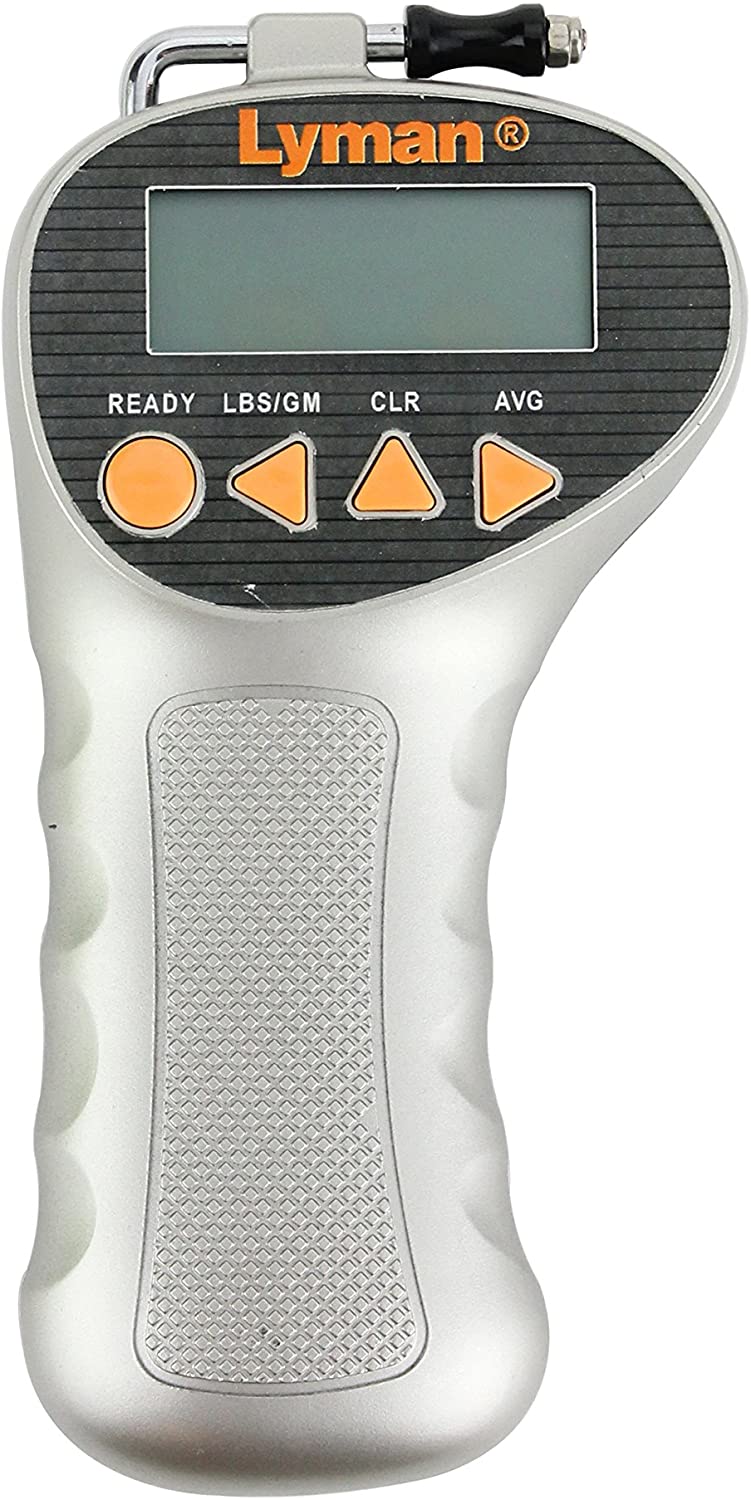
Lyman makes the list again with their digital trigger gauge. This gauge is one of the easiest to find and most popular trigger gauges on the market.
In fact, this was the first trigger gauge I ever purchased about a decade ago. But despite its popularity, it isn’t perfect.

The ergonomic shape provides a more comfortable grip than the Wheeler digital gauge.
It can measure in ounces or kilograms to the nearest tenth/whole gram, and also features an average pull weight function. Unlike the Wheeler, the Lyman’s screen is not backlit.
It also uses the same slightly curved trigger interface hook as the Lyman manual gauge, making it easy to center on the trigger. The hook arm can be rotated and locked into four different positions every 90 degrees.

My main issue with the Lyman digital gauge is that you must pull slower and more consistently than with any other gauge on this list.
If you pull ever so slightly too fast, the gauge will yield a much lower reading than it should. It is extremely easy to get aberrant readings with this gauge. This suggests sensitivity issues with the internal sensor.
I also noticed that the battery compartment likes to slide loose with only a little pressure. Not a big deal, but it has come loose on me a few times during use.
This isn’t a bad trigger gauge by any means, but it requires much more patience and caution to avoid bad readings. For digital gauges, I prefer the Wheeler.
Why Do I Need a Trigger Pull Gauge?
Truthfully, most shooters or gun owners don’t need a trigger pull gauge. They are niche tools that fall more under the “nice to have” category rather than the “gotta have it.”
A trigger pull gauge primarily satisfies your own curiosity, but it can also provide useful information.

For precision and competition shooters, knowing your pull weight can help you eliminate one more variable when it comes to looking for things that could potentially affect accuracy and split times. It is also nice to be able to compare the trigger pull on two different guns.
If you are considering upgrading one of your triggers, it is extremely helpful to know both your starting weight and your final modified weight.
If an aftermarket trigger says it has a 3 lb pull, but your trigger gauge reads 5.5 lbs, you know something is wrong, or it isn't as light as advertised.
Final Thoughts
Trigger pull gauges are definitely one of the most niche tools a firearms hobbyist can have, but they are nice to keep around for times when you just gotta know.

I can’t say I’ve ever needed to know what my trigger pull weight was, except for when I was trying to write a review of something, but I almost always want to know, even if it’s just for fun.
Do you have a trigger pull gauge? Why did you buy it? Let us know in the comments! For more awesome tools, take a look at our article on AR-15 Build Tools. Or if you're looking for trigger replacements, check out our list of the Best AR-15 Triggers and Best Glock Triggers!
Latest Updates
February 2023: Complete article overhaul. New testing was done using the Dvorak TriggerScan as a baseline comparison. Added the Lyman Mechanical Trigger Pull Gauge and Birchwood Casey Trigger Scale.